
A student of mine was traveling recently in an unfamiliar city.
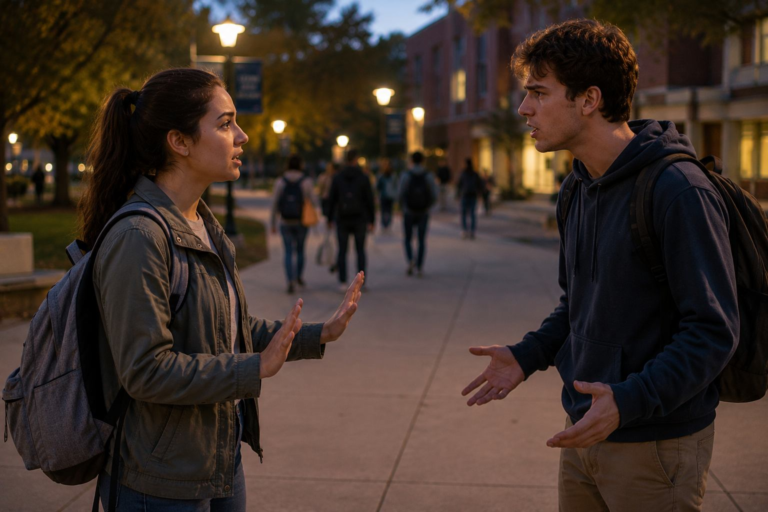
One night, while walking back to his hotel, he noticed a man farther down the street who seemed to be tracking his movements.
The man was bigger than him. The situation was uncertain. And before my student could fully explain why something felt wrong, his instincts had already noticed it.
He was afraid.
And that’s exactly when his training became useful.
Fear Can Be Useful Information
My student didn’t ignore what he was feeling or convince himself he was overreacting.
He paid attention.
He changed his pace and adjusted his route to see whether the other person’s behavior changed with him. He maintained distance. He looked for people, light, and activity instead of continuing toward a quieter part of the street.
Then he identified a busy storefront and moved toward it.
He stayed there until he was confident the situation had passed.
That’s situational awareness in practice.
There was no confrontation. No physical self-defense. No dramatic ending.
He simply recognized a potential problem early enough to give himself options.
But when he told me the story later, there was one thing bothering him.
“Gus, I was scared the whole time.”
He said it almost like the fear meant his training had failed.
It hadn’t.
Everything had worked.
Training Doesn’t Make Fear Disappear
I’ve been training in martial arts for more than 35 years and teaching self-defense for 25.
I still experience fear.
Training doesn’t remove that very human response, and it shouldn’t.
Fear is part of the body’s alarm system. When we perceive danger, our bodies begin preparing us to respond. Attention changes. Heart rate increases. Adrenaline enters the system. We become acutely aware that something requires our attention.
The challenge is learning what to do with that information.
Fear can become panic when we don’t have a plan.
With preparation, that same fear can become a signal:
Pay attention. Something has changed. Decide what you’re going to do next.
Situational Awareness Gives Fear Direction
The difference in my student’s story wasn’t that he remained perfectly calm.
It was that he had practiced what to do when he didn’t feel calm.
- He noticed.
- He assessed.
- He created distance.
- He identified a safer destination.
- He moved.
Each decision gave him another option and reduced his exposure to the potential threat.
That’s one of the reasons situational awareness is such an important part of personal safety education, particularly for college students and young adults who are beginning to travel, commute, and navigate unfamiliar places independently.
You can’t control every environment you enter.
You can become better at reading it.
Trust Your Instincts Without Jumping to Conclusions
Situational awareness doesn’t mean assuming every unfamiliar person is dangerous.
My student didn’t know the other man’s intentions.
He didn’t need to.
That’s an important distinction.
Personal safety decisions don’t always require absolute certainty. If someone’s behavior makes you uncomfortable, you can create distance without accusing them of anything. You can change direction. Enter a populated business. Call someone. Move toward other people.
You are allowed to respond to uncertainty before it becomes an emergency.
That isn’t paranoia.
It’s preparation.
Practice the Decisions Before You Need Them
College students encounter unfamiliar environments all the time.
A new campus.
A different city.
Public transportation.
Parties and social events.
Study abroad programs.
Internships.
Late-night walks back to a residence hall.
Most of those experiences are perfectly ordinary. But they also provide opportunities to practice simple habits that support personal safety.
Notice where you’re going.
Look for populated areas.
Know where you could go if you needed help.
Pay attention when someone’s behavior changes.
Keep enough distance to give yourself time to make a decision.
The purpose isn’t to move through life expecting danger.
It’s to move through life prepared to respond when something doesn’t feel right.
Courage Isn’t the Absence of Fear
There’s a common idea that confident people aren’t afraid.
I don’t believe that.
Confidence comes from knowing that fear doesn’t have to make the decision for you.
My student was afraid when he noticed the man behind him.
He was afraid when he changed direction.
He was afraid when he moved toward the storefront.
And he was probably still afraid while he waited there.
He didn’t need to become fearless.
He needed to keep making good decisions while fear was present.
That’s a much more useful definition of courage.
Fear Is Not the Enemy
At Krav Maga Essentials, we don’t teach students to become fearless.
We teach readiness.
That means developing situational awareness, trusting your instincts, recognizing changes in your environment, and having practical options when uncertainty appears.
Fear can be uncomfortable.
But it can also be valuable information.
- Listen to it.
- Look around.
- Create distance.
- Move toward safety.
- Feel afraid the entire time if you have to.
My student did.
And he went home safe.
Fear isn’t the enemy. Being unprepared for what comes next is.
The Krav Maga Essentials Team